Open-source software has always been one of WordPress’s greatest strengths. Thousands of plugins already solve common problems, allowing developers to focus their effort where it creates the most value.
While developing two WordPress plugins—Flipnzee Analytics and Flipnzee Auctions—an interesting lesson emerged: not every feature needs to be built from scratch.
The Initial Approach
The original plan was to implement a complete watchlist system inside the plugins.
The proposed feature set included:
- Watch listings
- Watch auctions
- AJAX-powered add/remove functionality
- User watchlists
- Watch counts
- Notification support
- Analytics integration
On paper, this sounded like a worthwhile addition.
Then came a simple question:
Does a mature WordPress plugin already solve this problem?
The answer was yes.
Discovering Existing Solutions
After a brief search, the free Favorites plugin was tested.
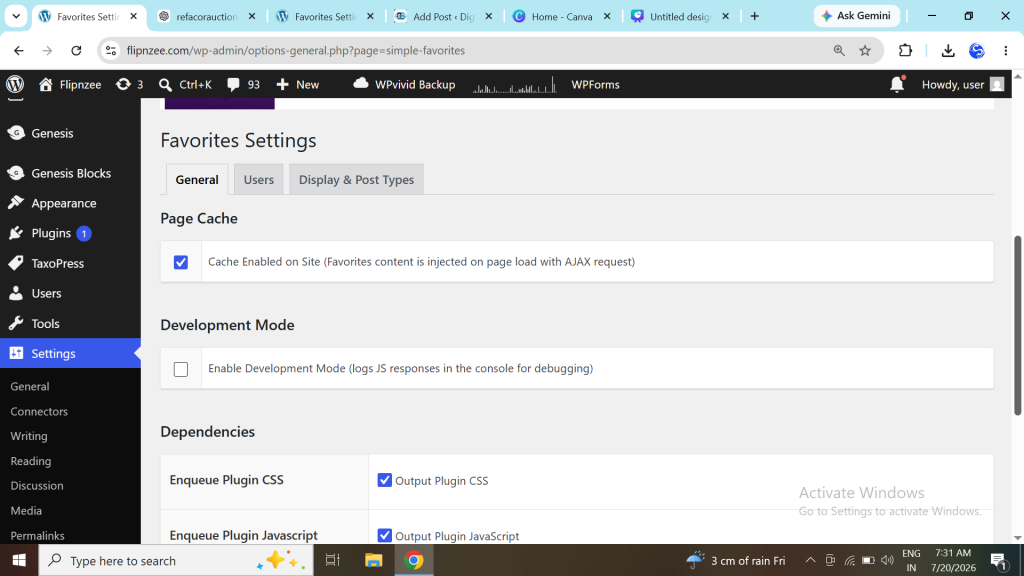
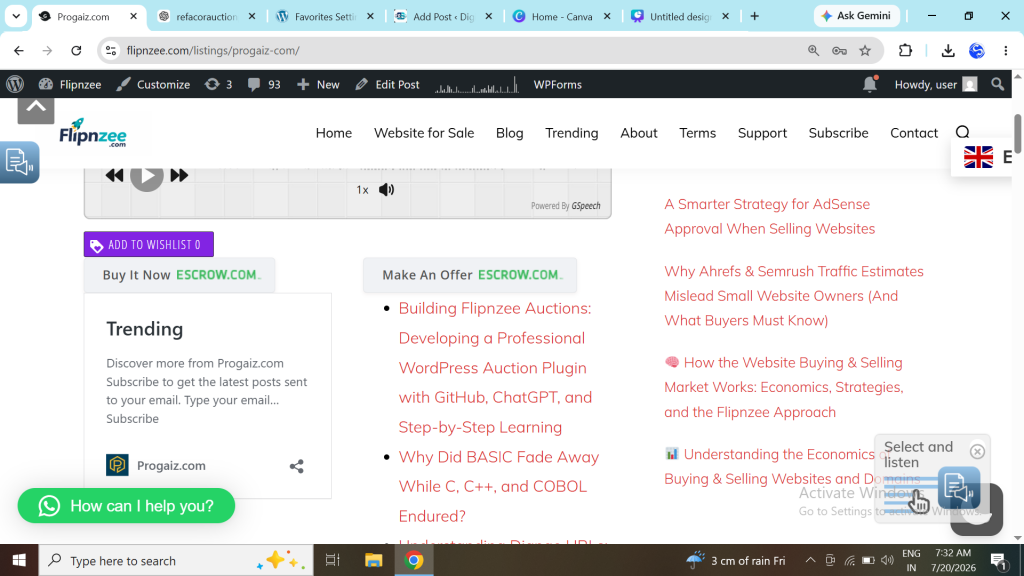
Within minutes it provided:
- AJAX-powered watch buttons
- User wishlists
- Watch counts
- Shortcodes
- Guest support
- Custom post type support
For a website marketplace where each listing is a custom post type, it fulfilled the immediate requirement with almost no development effort.
Instead of spending several days writing and testing a watchlist system, the feature became available after a few minutes of configuration.
The Difference Between Integration and Reinvention
This experience highlighted an important engineering principle.
Not every feature differentiates a product.
A watchlist is useful, but it is also a common capability that has already been implemented and tested by the WordPress community.
Integrating an existing solution can often be the more practical decision.
The real engineering effort should instead focus on features that are unique to the project.
Identifying the Real Value
For Flipnzee, the more distinctive capabilities include:
- Displaying Google Analytics statistics for individual website listings.
- Showing Google Search Console metrics directly on listing pages.
- Presenting traffic sources, countries, and cities to potential buyers.
- Integrating website valuation data.
- Supporting website-specific auctions rather than generic product auctions.
- Combining marketplace functionality with analytics in a single interface.
These are features that existing WordPress plugins generally do not provide together.
The Same Principle Applies to Auctions
WordPress already has several mature auction plugins.
Examples include:
- Ultimate Auction Pro
- Ultimate WooCommerce Auction
- YITH WooCommerce Auctions
- Simple Auctions
- WP Auctions
These plugins support features such as:
- Timed auctions
- Reserve prices
- Proxy bidding
- Buy Now options
- Bid histories
- Automatic winner selection
- Email notifications
For many use cases, these plugins are sufficient.
However, selling websites differs significantly from auctioning physical products.
Website buyers often expect additional information before placing a bid, including:
- Traffic statistics
- Organic search performance
- Domain information
- Monetization details
- Historical performance
Providing this context is where a specialised solution becomes valuable.
Build Where It Matters
A practical development strategy is to separate features into two categories.
Features That Can Be Integrated
These are common capabilities that already have stable, well-maintained implementations.
Examples include:
- Watchlists
- Login and registration
- Comments
- Email delivery
- Social sharing
- Backup utilities
- SEO optimisation
Features Worth Building
These are the features that define the product.
For Flipnzee, they include:
- Listing-specific analytics
- Website valuation
- Website marketplace workflows
- Digital asset auctions
- Escrow integration
- Buyer analytics
- Search Console reporting
- Market intelligence dashboards
These features are far less common and represent the project’s primary focus.
An Unexpected Benefit
Integrating existing plugins does not necessarily mean becoming dependent on them.
One approach is to wrap third-party functionality inside a small abstraction layer.
For example, a custom Flipnzee_Watchlist class could internally call a third-party watchlist plugin today, while allowing a future in-house implementation without changing the rest of the codebase.
This provides flexibility without sacrificing development speed.
Final Thoughts
Building software is not simply about writing more code.
It is also about deciding which code is worth writing.
The WordPress ecosystem already provides thousands of solutions for common problems.
Using those solutions where appropriate allows developers to spend more time solving the problems that are unique to their projects.
For specialised marketplaces—such as buying and selling websites—the greatest opportunity may not be in recreating familiar features, but in combining analytics, marketplace workflows, and domain-specific functionality into a cohesive experience.
Related Projects
- Flipnzee Listings – https://flipnzee.com/listings/
- Flipnzee Analytics (GitHub) – https://github.com/SplendidDigital/flipnzee-analytics
- Flipnzee Auctions (GitHub) – https://github.com/SplendidDigital/flipnzee-auctions
This experience serves as a reminder that good engineering is often about thoughtful integration as much as original implementation.