 by
by 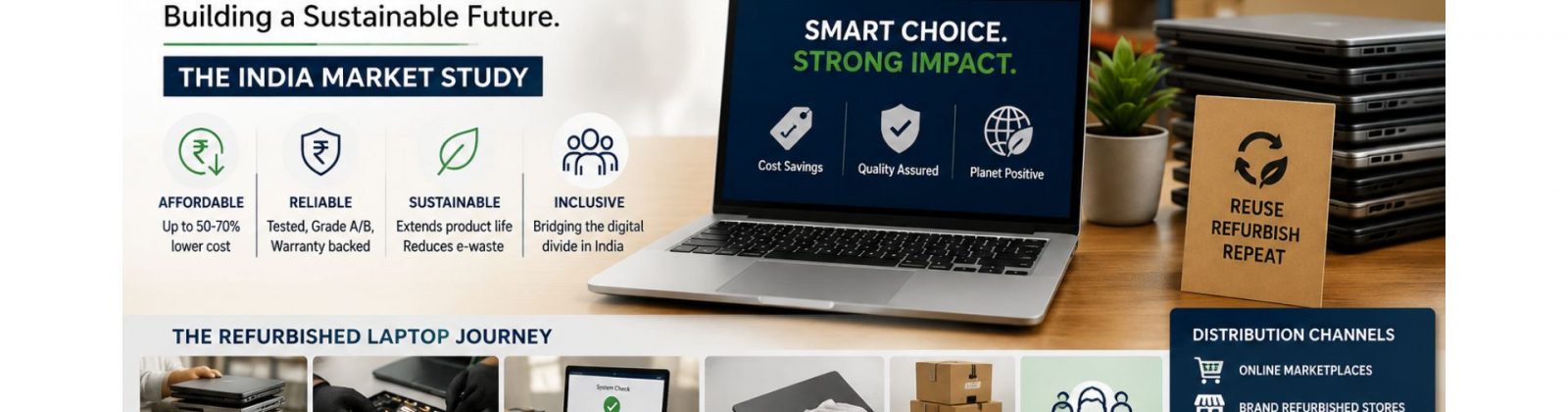
Research date: August 2026
Executive summary
The refurbished-laptop market in India is no longer merely a collection of small dealers selling old corporate computers. It is becoming an important part of the country’s broader recommerce, IT asset-disposition and circular-economy ecosystem.
There are several forces working simultaneously:
- New laptops are becoming more expensive, making older business-class machines relatively attractive.
- India has a large installed base of corporate laptops that eventually leave enterprise fleets.
- Business laptops such as Dell Latitude, HP EliteBook/ProBook and Lenovo ThinkPad are designed for relatively long useful lives.
- Students, freelancers, small businesses and households often don’t need the newest processor.
- Organised refurbishers increasingly add testing, grading, warranties, data wiping and logistics.
- Online commerce makes refurbished equipment available beyond traditional IT markets.
- Government e-waste rules increasingly formalise refurbishment and end-of-life processing.
- The industry creates a bridge between expensive new technology and affordable computing.
India’s PC market itself is expanding strongly. IDC reported 4.4 million traditional PC shipments in Q1 2026, up 31.1% year over year, with notebooks accounting for 3.3 million units. Commercial shipments were 2.8 million units. (IDC)
At the same time, market-research estimates for India’s refurbished-electronics industry vary enormously. One 2026 estimate puts it at $14.11 billion in 2025, while another estimates only $2.18 billion. (Market Research Future)
That discrepancy is important: there is no single clean number for the Indian refurbished-laptop market, partly because the market includes everything from professionally refurbished corporate machines to informal second-hand and repaired laptops.
The underlying opportunity, however, is quite real.
1. First: refurbished is not the same as used
This distinction is fundamental.
A used laptop may simply be a laptop that somebody previously owned and is now selling.
A refurbished laptop normally passes through some form of controlled process:
Used device → inspection → data wiping → repair/replacement → testing → grading → cleaning → OS installation → packaging → resale
Electronics Bazaar, for example, explicitly distinguishes used equipment from refurbished equipment: its refurbished devices are brought into its facility, tested, repaired where necessary and quality checked before being sold with warranty. (Electronics Bazaar)
This creates three broad categories:
| Category | What happens | Consumer risk |
|---|---|---|
| Used | Simply resold | High |
| Reconditioned | Cleaned/repaired | Medium |
| Professionally refurbished | Tested, repaired, graded, data wiped, warrantied | Lower |
And then there is another important category:
Open-box
An open-box machine may have been purchased and returned without significant use. It can therefore be substantially different from a three- or four-year-old corporate laptop.
2. Where do refurbished laptops actually come from?
This is perhaps the most important part of the business.
The supply doesn’t primarily originate with someone deciding:
“I have an old laptop. I’ll put it on a website.”
At scale, refurbished computing is largely a reverse supply chain.
A simplified model looks like this:
                    NEW LAPTOP
                        │
                        ▼
              Corporate / Consumer
                        │
                        ▼
                 First ownership
                        │
              ┌─────────┴─────────┐
              │                   │
       Corporate refresh      Consumer upgrade
              │                   │
              ▼                   ▼
        Bulk retirement       Trade-in / resale
              │                   │
              └─────────┬─────────┘
                        ▼
                 Asset Aggregator
                        │
                        ▼
              Refurbisher / ITAD
                        │
          ┌─────────────┼─────────────┐
          ▼             ▼             ▼
       Repair         Grade        Parts recovery
          │             │
          └──────┬──────┘
                 ▼
           Refurbished stock
                 │
       ┌─────────┼──────────┐
       ▼         ▼          ▼
    B2B       Retail      Marketplace
       │         │          │
       └─────────┼──────────┘
                 ▼
              Consumer
This is why the industry is better understood as recommerce + reverse logistics + refurbishment, rather than simply “second-hand laptops.”
3. The biggest source: corporate IT refresh cycles
One of the most attractive sources of refurbished laptops is the corporate sector.
Imagine a company with 5,000 employees.
It may purchase:
- Dell Latitude
- HP EliteBook
- Lenovo ThinkPad
for employees.
After perhaps three or four years, the company may replace those machines.
The old machines still work.
The corporation now has several choices:
- retain them,
- give them to employees,
- sell them,
- return them to a leasing company,
- give them to an IT asset-disposition company,
- auction them,
- recycle them.
This creates a very interesting secondary supply.
The global refurbished industry explicitly uses the term “off-lease” for such machines. Dell’s refurbished operation describes off-lease machines as systems previously leased to corporate customers, commonly for two to four years, which are subsequently inspected, repaired and refurbished. (Dell Refurbished)
Why business laptops are particularly attractive
Business machines tend to be:
- sturdier,
- easier to service,
- designed for long operating cycles,
- more modular,
- available in large batches,
- relatively standardized.
A three-year-old ThinkPad or Latitude may therefore have considerably more residual value than a cheap consumer laptop of similar age.
4. The Indian IT Asset Disposition opportunity
This is a much bigger concept than laptop resale.
It is called IT Asset Disposition — ITAD.
An enterprise may hire an ITAD company to manage:
- collection,
- transportation,
- asset inventory,
- data destruction,
- valuation,
- refurbishment,
- resale,
- recycling,
- certificates of destruction,
- compliance.
One current industry estimate puts India’s ITAD market at approximately $1.73 billion in 2025, forecasting $5.67 billion by 2033 at a 15.7% CAGR. Importantly, computers/laptops were the largest revenue-generating type segment in that estimate. (Grand View Research)
This is significant because it suggests that the opportunity isn’t merely:
“Buy an old laptop and sell it.”
It is increasingly:
“Manage the entire lifecycle of corporate IT equipment.”
5. The Indian supply chain
A practical Indian distribution chain can look like this:
Stage 1 — Original owner
Sources include:
- corporations,
- BPOs,
- banks,
- IT companies,
- educational institutions,
- government departments,
- leasing companies,
- consumers.
Stage 2 — Collection / aggregation
Equipment is accumulated by:
- ITAD companies,
- corporate buyback companies,
- refurbishers,
- wholesalers,
- brokers,
- auction houses,
- trade-in platforms.
Stage 3 — Sorting
Machines are separated into:
A. Direct resale
Good condition, minimal intervention.
B. Refurbishment
Requires cleaning, repair, SSD/RAM/battery replacement etc.
C. Parts harvesting
Machine isn’t economical to refurbish but components have value.
D. Recycling
Machine has reached economic end-of-life.
This is an extremely important economic principle:
Not every old laptop should be refurbished.
The refurbisher has to decide where the residual value is highest.
6. Refurbishment itself is a value-creation operation
Suppose an old corporate laptop arrives.
It might have:
- scratched casing,
- worn keyboard,
- weak battery,
- 4 GB RAM,
- old HDD,
- dirty cooling system,
- outdated Windows installation.
A refurbisher might:
- securely erase the previous owner’s data;
- inspect motherboard;
- test display;
- test keyboard;
- test trackpad;
- test ports;
- test Wi-Fi/Bluetooth;
- test speakers;
- test webcam;
- test battery;
- replace HDD with SSD;
- upgrade RAM;
- replace battery if economical;
- clean the machine;
- install operating system;
- run diagnostics;
- assign cosmetic grade;
- photograph it;
- package it;
- sell it with warranty.
This is where much of the economic value is created.
Cashify, for example, currently advertises a 32-step quality check for refurbished laptops and offers condition grades, warranty and return protection. (Cashify)
7. Why the SSD upgrade is particularly important
There is an interesting economics here.
A five-year-old laptop with:
8 GB RAM + HDD
may feel painfully slow.
Replace the HDD with an SSD and clean the operating system, and the perceived performance can change dramatically.
This means the refurbisher isn’t necessarily trying to make the laptop “new.”
Instead, the objective is:
restore enough performance for the intended use at the lowest possible refurbishment cost.
That is a very different engineering philosophy from manufacturing a new laptop.
8. Grading creates a market within the market
Refurbished equipment is frequently graded.
For example:
Grade A
- very good cosmetic condition
- little visible wear
- fully tested
Grade B
- visible scratches
- normal signs of use
- fully functional
Grade C
- heavier cosmetic wear
- potentially repaired/reconditioned
- cheaper
Cashify currently uses Fair, Good and Superb condition categories for refurbished laptops. (Cashify)
This creates price discrimination.
The same underlying laptop can be sold to different consumers at different price points.
Someone who wants:
“I want it to look almost new”
will pay more.
Someone who says:
“I don’t care about scratches; I just need a reliable machine”
can pay less.
9. The distribution channels in India
The market is actually composed of several channels.
Channel A — Manufacturer/OEM refurbishment
The strongest trust model.
Example:
Corporate customer → OEM → refurbishment → consumer
The OEM has:
- original parts,
- technical documentation,
- brand credibility,
- warranty infrastructure.
This is attractive to buyers who are uncomfortable with independent refurbishers.
Channel B — Organised refurbishers
Companies acquire equipment and operate their own refurbishment and resale operation.
Examples include:
Electronics Bazaar says it sources quality used PCs from corporates, refurbishes and tests them, and sells them with warranty and buyback programs. (Electronics Bazaar)
10. B2B wholesale
This is another important layer.
A large refurbisher may not want to sell every laptop individually.
Instead:
Refurbisher → wholesaler → retailer → consumer
or:
Refurbisher → reseller
This is particularly useful when somebody needs:
- 20 laptops,
- 50 laptops,
- 100 laptops,
- 500 laptops.
Current Indian B2B suppliers explicitly target companies, schools, resellers, retailers, startups, NGOs and training institutes. (Radiant Info Solutions Pvt. Ltd.)
This makes refurbished laptops particularly interesting for:
- coaching centres,
- schools,
- colleges,
- BPOs,
- startups,
- NGOs,
- small businesses,
- training institutes.
11. Local IT markets remain important
India also has an enormous informal/semi-organised ecosystem.
Examples include major computer markets such as:
- Nehru Place, Delhi
- Lamington Road, Mumbai
- SP Road, Bengaluru
- local IT markets in Hyderabad, Chennai, Kolkata and other cities.
These markets perform functions beyond simple retail.
They also provide:
- repairs,
- parts,
- component harvesting,
- motherboard repair,
- upgrades,
- assembly,
- wholesale,
- brokerage.
The informal ecosystem can therefore sometimes refurbish machines that an organised company would classify as uneconomical.
A recent investigation into Delhi’s Nehru Place documented technicians combining usable components from old machines to create inexpensive functioning laptops. (The Verge)
This is the low-cost end of the circular economy.
12. Online marketplaces are changing the distribution model
The traditional model was:
supplier → local dealer → consumer
The internet changes it to:
supplier → refurbisher → website/marketplace → consumer
This has several advantages.
The seller can display:
- exact model,
- processor,
- RAM,
- SSD,
- battery condition,
- cosmetic grade,
- photographs,
- warranty,
- return policy.
Amazon Renewed, for example, positions refurbished products around inspection/testing, seller-backed warranty and lower prices. (About Amazon India)
This is important because trust is arguably the biggest problem in refurbished electronics.
13. The consumer’s biggest problem is not price
It is uncertainty.
A consumer buying a ₹20,000 refurbished laptop is really asking:
“What exactly am I getting?”
There are potentially enormous differences between two laptops both advertised as:
“Dell Latitude i5 refurbished.”
One might have:
- 90% battery health,
- original display,
- original keyboard,
- 16 GB RAM,
- SSD,
- genuine Windows,
- six-month warranty.
Another might have:
- replacement screen,
- weak battery,
- mixed components,
- cosmetic damage,
- questionable Windows activation,
- no meaningful warranty.
Both can legally be described by sellers as “refurbished” in ordinary commercial usage.
Therefore:
The real product is not the laptop.
It is trust around the laptop.
14. Why refurbished helps Indian consumers
There are several layers of consumer benefit.
14.1 Lower acquisition cost
This is obviously the primary benefit.
A consumer can potentially buy a higher-tier business laptop for the price of a lower-tier new consumer machine.
For example, instead of buying:
new entry-level laptop
the consumer might buy:
refurbished business-class laptop
with better:
- keyboard,
- build quality,
- ports,
- display,
- CPU,
- RAM,
- storage,
- serviceability.
15. It democratizes access to computing
This may be more important than the financial benefit.
Consider:
Student
Needs:
- browser,
- Office,
- programming,
- Zoom/Meet,
- PDFs.
They may not need a ₹60,000 machine.
Freelancer
Needs:
- browser,
- WordPress,
- VS Code,
- accounting,
- Photoshop/light design.
Small business
Needs:
- billing,
- Excel,
- accounting,
- CRM,
- email.
School
Needs:
- 30 computers.
In all these cases, refurbished equipment can dramatically reduce the capital requirement.
16. Refurbished laptops can reduce the digital divide
This is particularly relevant in India.
PC penetration remains relatively low compared with smartphones. Economic Times, citing IDC data, reported household PC penetration at around 13–15% in 2024, compared with 6–8% in 2019. (The Economic Times)
That means there remains enormous room for computer adoption.
A refurbished laptop can become a first computer rather than merely a cheaper replacement computer.
That changes the social economics.
17. Environmental benefit
The environmental argument is also substantial.
The hierarchy should ideally be:
Reuse → refurbish → repair → parts recovery → recycle
rather than:
buy → use briefly → discard → manufacture another.
Every additional useful year obtained from a laptop potentially delays:
- mining,
- semiconductor manufacturing,
- display manufacturing,
- battery manufacturing,
- transportation,
- packaging,
- eventual disposal.
This is why refurbished technology fits naturally into the circular economy.
18. India’s e-waste regulation is making the ecosystem more formal
India’s E-Waste Management Rules, 2022 came into force on 1 April 2023 and cover manufacturers, producers, refurbishers, dismantlers and recyclers. (IEA)
Importantly, CPCB states that every refurbisher of e-waste must register on the E-Waste EPR portal and meet specified requirements, including relevant pollution-control authorisations. (Central Pollution Control Board)
This is significant.
The future Indian refurbishing industry is therefore likely to become increasingly:
- documented,
- traceable,
- GST-compliant,
- environmentally regulated,
- data-security conscious.
19. There is another important Indian regulation: imports
This is where the Indian market becomes particularly interesting.
India does not simply allow unlimited importation of old laptops.
Under the Foreign Trade Policy 2023, certain categories of second-hand goods are restricted. The policy specifically lists desktop computers and refurbished/reconditioned spares of PCs/laptops among restricted categories, and other notified electronics/IT goods can also be subject to authorisation and compulsory-registration conditions. (DGFT Content)
Therefore, a business should not casually assume:
“I’ll import a container of used laptops from abroad.”
The regulatory treatment depends on exactly what is being imported and under what classification.
This helps explain why domestic corporate liquidation, ITAD and buyback channels can be strategically valuable in India.
20. The consumer-to-refurbisher channel
There is another supply source:
Consumer trade-in
For example:
Consumer → Cashify → refurbishment → new consumer
Cashify currently offers an online valuation and pickup process for selling old laptops, illustrating how consumer devices can enter a structured recommerce pipeline. (YouTube)
This is fundamentally different from:
Consumer → OLX/Facebook Marketplace → another consumer
because the refurbisher becomes the intermediary responsible for:
- valuation,
- logistics,
- testing,
- refurbishment,
- warranty,
- resale.
21. C2C versus organised recommerce
This distinction is crucial.
C2C
Seller ───────────────► Buyer
Advantages:
- potentially lowest price.
Problems:
- no meaningful warranty,
- no standardized grading,
- no professional testing,
- fraud risk,
- payment risk,
- return problems.
Organised recommerce
Seller
  ↓
Aggregator
  ↓
Inspection
  ↓
Refurbishment
  ↓
Grading
  ↓
Warranty
  ↓
Consumer
The organised player charges a margin for solving the uncertainty.
That margin is not necessarily “middleman profit.”
It pays for risk absorption.
22. Where does the refurbisher make money?
The economics can be thought of as:
Resale price
minus
- acquisition cost
- transportation
- sorting
- labour
- replacement components
- battery
- SSD/RAM
- testing
- packaging
- warranty reserve
- marketplace fees
- payment costs
- returns
- inventory carrying cost
- taxes
- overhead
=
gross contribution
This is why refurbishment is an operational business rather than merely a trading business.
A seller who buys a laptop cheaply but has poor refurbishment discipline can actually lose money.
23. Inventory risk is a major issue
Imagine buying 1,000 laptops.
You don’t know in advance that all 1,000 will be equally attractive.
Perhaps:
- 300 are immediately resellable,
- 400 require minor repair,
- 150 require batteries,
- 80 require displays,
- 50 are parts machines,
- 20 are scrap.
Therefore the profitability of the entire batch matters more than the profitability of one laptop.
This is why procurement expertise becomes a competitive advantage.
24. Data destruction is another hidden business
Corporate laptops contain sensitive information.
Before resale, data must be securely erased.
This is especially important for:
- banks,
- IT companies,
- hospitals,
- government,
- BPOs,
- law firms,
- financial companies.
Therefore a serious corporate refurbishing business isn’t simply selling laptops.
It is also selling:
secure IT asset disposal.
That is a much more valuable B2B proposition.
25. Why corporate customers may actually prefer refurbished
This may sound surprising.
A small business with 50 employees might not need the latest laptops.
Suppose employees mostly use:
- browser,
- email,
- Microsoft Office,
- accounting,
- CRM,
- cloud applications.
A professionally refurbished business laptop may be perfectly adequate.
The company can therefore redirect capital toward:
- salaries,
- marketing,
- inventory,
- software,
- expansion.
Electronics Bazaar currently markets refurbished equipment specifically to businesses on this basis and advertises multi-year warranties for some business equipment. (Electronics Bazaar)
26. Schools and institutions could be a huge market
This is an underappreciated opportunity.
Imagine a school needing:
100 computers
Buying new machines could require a substantial capital budget.
Refurbished machines can potentially reduce acquisition costs while providing adequate functionality.
The Karnataka government, for example, has recently considered structured reuse of corporate laptops for rural schools and government institutions. (The Economic Times)
That is an excellent illustration of the social value of the secondary market.
27. Why the market is becoming more attractive in 2026
There is a particularly interesting development happening now.
New computer prices are under pressure from component costs.
IDC noted that India’s PC market grew strongly in Q1 2026 even while component shortages were pushing prices upward. (IDC)
Recent Indian reporting has also linked rising hardware costs with increased interest in refurbished devices. (Times of India)
This creates an unusual situation:
New hardware becomes more expensive
↓
Consumers reconsider their price/performance expectations
↓
Older premium hardware becomes more attractive
↓
Refurbished market gains relative value
This is particularly powerful for business-class laptops.
28. Why the Indian market may be structurally attractive
India has several characteristics favourable to refurbishment.
1. Huge population
Even a small percentage of consumers adopting refurbished PCs represents millions of potential buyers.
2. Price sensitivity
Indian consumers are generally highly conscious of value.
3. Large IT sector
India has an enormous corporate computing installed base.
4. Growing digital adoption
More people need computers for education and work.
5. Repair culture
India already has a large ecosystem of technicians and parts markets.
6. E-commerce
Online channels allow refurbished sellers to reach Tier II and Tier III markets.
7. E-waste pressure
Reuse provides an economically productive alternative to immediate recycling.
29. But the market has a serious trust problem
This is probably the biggest weakness.
The Indian buyer may ask:
“Is this really refurbished?”
“Was the battery replaced?”
“Is the display original?”
“Was it stolen?”
“Was the motherboard repaired?”
“Is the Windows licence genuine?”
“Is the SSD new?”
“How much life is left?”
“Will the seller disappear after 30 days?”
These questions explain why warranty and reputation are becoming central to the organised market.
Recent Indian consumer discussions illustrate both interest in refurbished laptops and continuing concerns about battery health, component replacement and seller reliability. (Reddit)
30. The opportunity is therefore not simply “sell cheaper laptops”
This is perhaps the most important conclusion of the study.
The winning proposition is likely to be:
“Make buying a refurbished laptop almost as predictable as buying a new laptop.”
That means providing:
- verified specifications,
- battery health,
- SSD health,
- cosmetic grade,
- component disclosure,
- serial-number verification,
- data-wipe certification,
- warranty,
- return period,
- genuine OS,
- clear photographs,
- transparent invoice.
The closer the industry gets to this standard, the more consumers will move from used to refurbished.
31. A useful way to segment the Indian market
I would divide the market into five layers.
| Segment | Typical buyer | Main requirement |
|---|---|---|
| Ultra-budget | students, low-income users | lowest price |
| Value consumer | families, freelancers | price + reliability |
| Professional | developers, designers | specifications |
| SMB | companies | price + warranty + bulk availability |
| Institutional | schools/NGOs/government | volume + service + compliance |
Each segment requires a different business model.
32. The most interesting segment may be B2B
Consider this:
Selling 1 laptop to 1 consumer involves:
- marketing,
- payment,
- shipping,
- customer support,
- possible return.
Selling 100 laptops to a company can mean:
- one procurement discussion,
- one invoice,
- one shipment,
- one configuration,
- one service relationship.
Therefore:
B2C provides potentially higher retail margins.
But:
B2B provides potentially better inventory velocity and predictable demand.
The optimal business could combine both.
33. The ideal distribution model
A sophisticated Indian refurbished-laptop business could look like:
                CORPORATE FLEETS
                       │
                       ▼
              ITAD / BUYBACK
                       │
                       ▼
                BULK INVENTORY
                       │
          ┌────────────┴────────────┐
          │                         │
          ▼                         ▼
     REFURBISHING              PARTS RECOVERY
          │
          ▼
     QUALITY CONTROL
          │
          ▼
       GRADING
          │
     ┌────┼─────┐
     │    │     │
     ▼    ▼     ▼
    B2B   B2C  WHOLESALE
     │    │     │
     └────┼─────┘
          ▼
       BUYERS
And after the second ownership cycle:
Second owner
     ↓
Trade-in
     ↓
Refurbish again
     ↓
Third owner
     ↓
Parts
     ↓
Recycling
That is a circular economy, rather than a conventional linear product market.
34. The “second life” concept is economically powerful
A new laptop might have:
Life 1: corporate employee
Then:
Life 2: small business
Then:
Life 3: student
Then:
Life 4: Linux/home server/learning machine
Then:
Parts
Then:
Recycling
The same physical hardware can therefore generate economic value several times.
This is the fundamental reason recommerce works.
35. What prevents the market from becoming huge overnight?
There are several bottlenecks.
Supply
Not enough good-quality machines may be available at attractive acquisition prices.
Quality
Refurbishment standards vary enormously.
Trust
Consumers remain uncertain.
Working capital
Large batches require capital.
Inventory
Old technology depreciates quickly.
Components
Batteries, displays and motherboards can be expensive.
Logistics
Reverse logistics is complicated.
Warranty
Every refurbished unit carries some probability of failure.
Regulation
Formal refurbishers face compliance obligations.
36. The paradox of the refurbished laptop market
There is a fascinating paradox:
The cheaper the acquisition price, the greater the potential margin — but also potentially the greater the refurbishment risk.
A ₹10,000 machine that needs ₹6,000 of repairs isn’t necessarily better than a ₹14,000 machine requiring ₹1,000 of work.
Therefore professional refurbishers are really experts at predicting residual value.
37. Market estimates should therefore be treated carefully
This is worth emphasizing.
Different market-research firms currently publish radically different numbers for India’s refurbished-electronics market.
For example:
- Market Research Future estimates $14.11 billion in 2025, growing to $48.75 billion by 2035. (Market Research Future)
- Deep Market Insights estimates approximately $2.18 billion in 2025, rising to $4.21 billion by 2034. (Deep Market Insights)
- Another industry estimate puts India’s refurbished-electronics market at $17.3 billion in 2025. (Mobility Foresights)
These should not be treated as directly comparable facts.
The definitions may differ regarding:
- smartphones,
- laptops,
- appliances,
- used versus refurbished,
- formal versus informal trade,
- wholesale versus retail,
- revenue versus transaction value.
So I would not use any single one of these figures in an investment pitch without examining the underlying methodology.
The more reliable conclusion is directional:
India has a substantial and growing secondary electronics market, with laptops positioned as an important and potentially fast-growing component.
38. A potentially important business opportunity
There is an interesting gap between:
informal used-laptop market
and
large organised refurbishers.
The informal market can offer:
low prices
but often lacks:
- standardisation,
- warranty,
- transparency,
- documentation.
The large organised players provide:
trust
but must carry:
- warehouses,
- employees,
- inventory,
- logistics,
- customer support,
- technology infrastructure.
There may therefore be room for technology-enabled marketplaces that standardise smaller refurbishers.
39. What such a marketplace could provide
Imagine a platform where a refurbisher lists:
Dell Latitude 5420
with:
- i5-11th Gen
- 16 GB RAM
- 512 GB SSD
- battery health: 86%
- display: original
- keyboard: original
- SSD: replaced
- cosmetic grade: B+
- diagnostic report
- serial number
- data-wipe certificate
- 6-month warranty
- 7-day return
- actual photographs
That is much more valuable than:
“Dell Latitude i5 refurbished — ₹25,000.”
The platform becomes a trust layer.
40. My assessment of the Indian opportunity
I would rate the structural attractiveness approximately as follows:
| Factor | Assessment |
|---|---|
| Consumer demand | High |
| Corporate supply | Very high |
| B2B opportunity | Very high |
| Environmental rationale | Very strong |
| Price advantage | Strong |
| Online distribution potential | High |
| Competition | Increasing |
| Trust problem | High |
| Operational complexity | High |
| Capital requirement | Medium–High |
| Regulatory complexity | Medium–High |
| Long-term potential | Very strong |
41. The bigger picture
The most interesting way to think about the industry is not:
“Used laptops are cheap.”
It is:
“Computing hardware has a residual economic life that the traditional new-product market does not fully capture.”
The refurbished industry monetises that residual life.
And India is particularly well suited to it because the country combines:
large IT fleets + price-sensitive consumers + growing digital adoption + repair expertise + e-commerce + enormous population + e-waste challenges.
The result is a potentially powerful circular supply chain.
42. Final conclusion
The Indian refurbished-laptop industry is moving through an important transition.
It began largely as:
local dealers selling used corporate machines.
It is increasingly becoming:
corporate asset recovery → professional refurbishment → quality grading → warranty → B2B/B2C distribution → second and third ownership → eventual recycling.
That transformation is important.
The laptop itself is only one component of the product.
The real value increasingly lies in the infrastructure around it:
procurement + authentication + refurbishment + data security + grading + logistics + warranty + marketplace trust.
That is why organised recommerce companies can command a premium over an ordinary used-laptop dealer.
And I think there is an especially interesting opportunity in India at the intersection of refurbished laptops, corporate IT asset disposition, wholesale distribution and trusted online marketplaces.
The market doesn’t necessarily need another website that simply lists used laptops.
It needs better market infrastructure that makes the secondary laptop market more transparent and predictable.
One particularly interesting observation
India’s refurbished market could eventually resemble the used-car industry.
The consumer doesn’t necessarily want:
“a used car.”
They want:
“a certified car, inspected, graded, financed, warranted and transferable.”
The same transition can happen with laptops:
Used laptop → Refurbished laptop → Certified refurbished laptop → Trusted secondary computing asset.
That evolution could be one of the most important developments in India’s computing market over the next several years.

Leave a Reply